 PALAWAN
ECO
PALAWAN
ECO
November 3, 2025
With many species being driven to the point of near extinction due to humanity’s activities, Palawan’s future looks incredibly bleak. However, not all hope is lost. There are many solutions and initiatives already in place, but how effective are they?
ECAN Zoning System
Under the Strategic Environmental Plan (SEP) for Palawan Act (RA 7611 of 1992), the Environmentally Critical Areas Network (ECAN) framework was established and enacted, classifying areas into zones with graded protection. The image below enumerates each ECAN zone and the corresponding activities allowed within them.
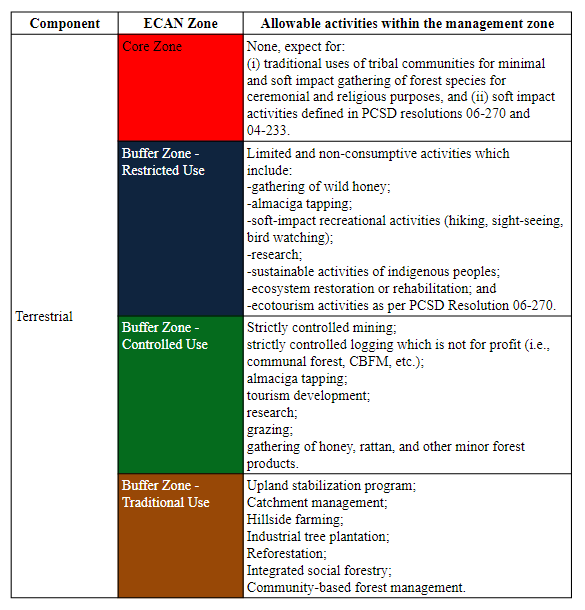
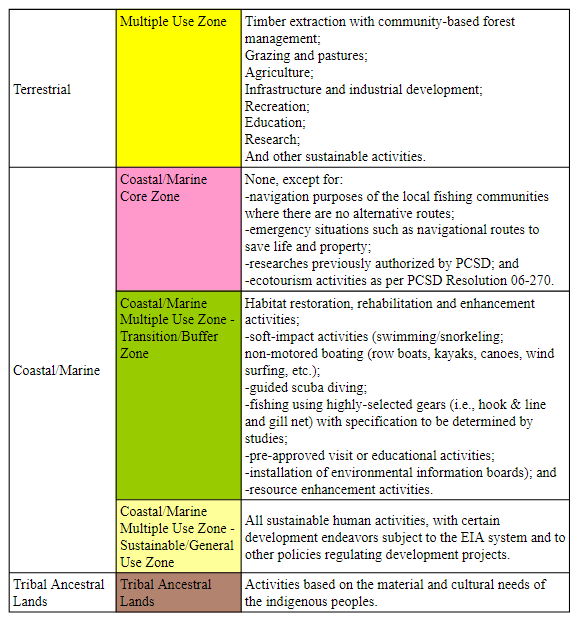
Core zones are areas with maximum protection that are absolutely off-limits to the public and companies due to them housing a lot of endangered species. Buffer zones are areas that usually wrap around core zones and act as a “buffer” or a protective barrier for the more protected core zone, allowing but limiting and regulating human activities. Multiple use zones offer the most freedom, allowing all sustainable human activities.
The ECAN Zoning is currently being enforced by requiring all activities or projects in Palawan to first get a SEP clearance to ensure that the project meets the regulations established under ECAN.
ECAN resource management plans for the municipalities of Busuanga, Coron, Roxas, El Nido, Dumaran, Narra, Taytay, Brookes-Point, and the city of Puerto Prinsesa are published in the Palawan Council for Sustainable Development’s (PCSD) official website. In each report, the most common challenges mentioned were inappropriate zoning classifications for certain areas, and the persistence of parties carrying out illegal activities in restricted areas, especially core zones.
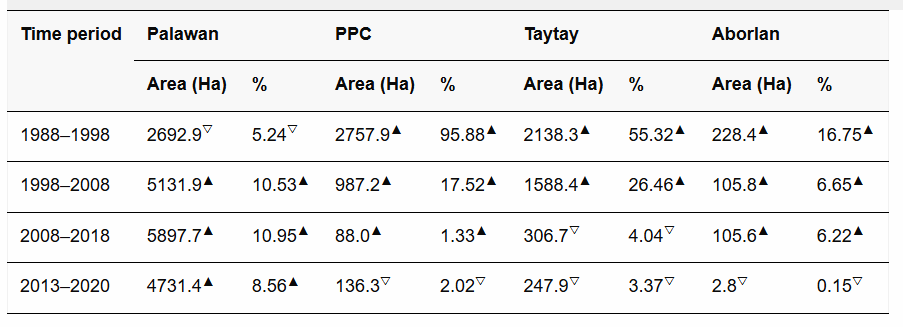 Multi-spatiotemporal analysis of changes in mangrove forests in Palawan, Philippines: predicting future trends using a support vector machine algorithm and the Markov chain model
The table above shows the increase or decrease in hectares covered by mangrove forests in Puerto Prinsesa City, Taytay, and Aborlan. We see that around the time the ECAN was enacted, in 1992, the increase in mangrove forests was astronomical, with Puerto Prinsesa City even reaching a 95% increase, but in recent years, it has turned into a decrease. While the decrease rate is still relatively low, if we are not careful, the downward trend may continue.
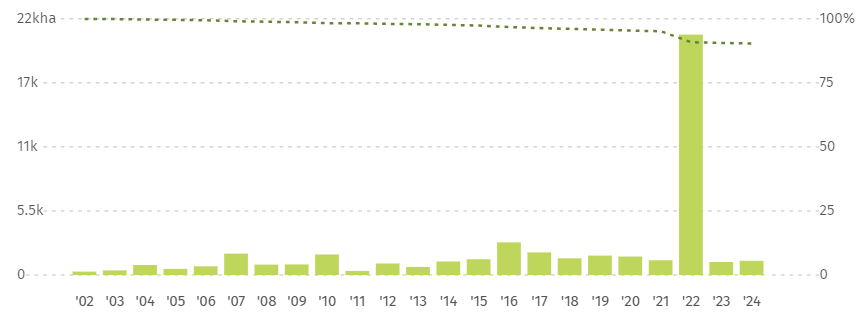 Global Forest Watch
The chart shows the hectares of humid primary forest loss in Palawan per year, from 2002 to 2024. The source highlighted that Palawan lost a significant total of 46 thousand hectares in this period. We can see the average total hectares lost per year increasing in recent years.
Overall, the ECAN system itself seems to be a solid framework for zoning, but the reported data suggests the need for stronger enforcement and support, especially from the government. Consistence may also be a problem, as we see an important increase in mangrove forests from 1988 to 1998, yet decreases are happening from 2013 to 2020. There is also a need to classify areas properly, since according to the 2015 to 2017 reports from LGUs about ECAN resource management, there are still areas that need correcting, yet there are still no available updates on whether the corrections were approved or enacted. The report from the Municipality of Busuanga alone mentions 15 different areas that needed correcting for their classifications. Overall, the ECAN zoning system has the potential to be effective, but is being held back by insufficient enforcement and improper classifications.
Poachers to Conservationists
The Philippine Cockatoo Conservation Programme (PCCP) by Katala Foundation Inc. (KFI) hires former poachers as wildlife wardens, specifically for cockatoos. Since poachers are familiar with care for cockatoos, it is a win-win situation where the former poachers are given a stable livelihood, and also for KFI since they gain knowledge on cockatoos’ biology, how to treat and feed them, and their nest locations. The PCCP’s poachers to wildlife wardens program, since its first implementation in 1999, has since been replicated to five other PCCP sites.
The Palawan Pangolin Conservation Program (PPCP) is also run by the KFI and soon followed a similar framework but for Palawan Pangolins.
When the program was newly established in 1998, there were only 23 to 25 cockatoos left. But in early 2019, there were close to 400 cockatoos on the island. In 2006, Rizal, Palawan, it was reported that 13 out of 18 poachers became wildlife wardens. The initial salary of wildlife wardens from 1998 was less than ₱50 per working day and has been increased to ₱200. They now also receive benefits such as accident assurance, SSS, and PhilHealth.
The poachers to wildlife wardens framework has shown impressive growth. Not only did it show a 72% success rate in converting ex-poachers to wardens (13 out of 18), the fact that the salary was raised to four times its original amount, and the fact that the cockatoo population grew 16 times the original count, shows that this framework is beneficial not only to the ex-poachers, but also to Palawan’s biodiversity, which makes it an effective, win-win solution. Still, considering that the minimum wage in Palawan is ₱400, a raise in salary may be recommended.
Ecotourism and CBST
According to the The International Ecotourism Society (TIES), ecotourism is defined as the “responsible travel to natural areas that conserve the environment, sustains the well-being of the local people, and involves interpretation and education”. Community-Based Sustainable Tourism (CBST) is a form of tourism, where local communities have ownership and receive majority of the benefits earned from the tourism initiative.
One of the more known tours implementing CBST and enforcing ecotourism is the Sabang Mangrove Paddleboat Tour in Puerto Prinsesa City. In this tour, the boat guides or paddlers are local community members (who may have been originally fishers and farmers), and they share their knowledge about the mangrove ecosystem to tourists. The tour only makes use of paddleboats as suggested in its name, no motorized boats, to ensure that marine inhabitants are not disturbed by noise and pollution from carbon.
The El Nido Island Hopping Tours usually have a required eco-tourism fee (usually around ₱200 to ₱400). This is especially impactful, since the municipality of El Nido has declared that 50% of the fund is legally mandated for environmental protection, rehabilitation, and management in the new Eco-Tourism Development (ETDF) rates.
The Ihawig Firefly Watch also uses small, quiet paddle boats to minimize impact on the surrounding ecosystem. Tourists are prohibited from using flash photography and their own flashlights. Only guides using low-intensity red flashlights are allowed, to not disturb the fireflies.
The PPSRNP enforces strict rules on visitor count and opening and closing hours, as well as the type of light that can be used during the tour.
All tours mentioned, and majority of tours in Palawan in general, employ CBST, where local residents are in direct ownership of the business and the revenue goes directly back to the community, helping the community fund even more ecotourism projects or eco-friendly projects. Most tours employ strict regulations on how many tourists can visit a particular place at a time.
In 2019, the PPSRNP was able to generate a revenue of ₱108,000,000 from entrance fees, which funded the salaries of park rangers and monitoring activities for wildlife. The Expanded National Integrated Protected Areas Act (E-NIPAS) states that 75% of revenues generated from protected areas like the PPSRNP should be retained through the Integrated Protected Area Fund (IPAF). The IPAF is usually reinvested into the park’s operations and maintenance, and also for the creation of other sustainable, eco-friendly projects dedicated to protecting the environment. Considering also the entrance fees and the reported visitors per year, the Sabang Mangrove Paddleboat Tour in Puerto Prinsesa City, El Nido Island Hopping Tours, and Ihawig Mangrove Firefly Watch are all estimated to bring in millions of pesos per year.
The data shows the ability of ecotourism and CBST to generate revenue. The revenue is then in turn reinvested into the community, funding the salaries of local residents, and even the creation of new, sustainable, eco-friendly projects that will help the environment and also Palawan’s biodiversity. This approach helps foster a community that is motivated to take care of their environment since a big part of their livelihood is sustained by it. Given this, it can be said that ecotourism and CBST is an effective solution in preserving Palawan’s biodiversity while not compromising the locals’ livelihoods, and instead boosting their profits, and motivating them to take care of the environment.
In conclusion...
Amid the sea of devastating news of species being pushed to near extinction, there is still hope for Palawan to retain its colorful, biodiverse ecosystem through the united efforts of local residents. Regulatory bodies must ensure that proper and consistent support is extended to the community for the initiatives to prosper.
Disclaimer: PalawanEco is a school project made for educational purposes only.